The Invisible Ultra: Why Chronic Pain Warriors Are Already Endurance Athletes
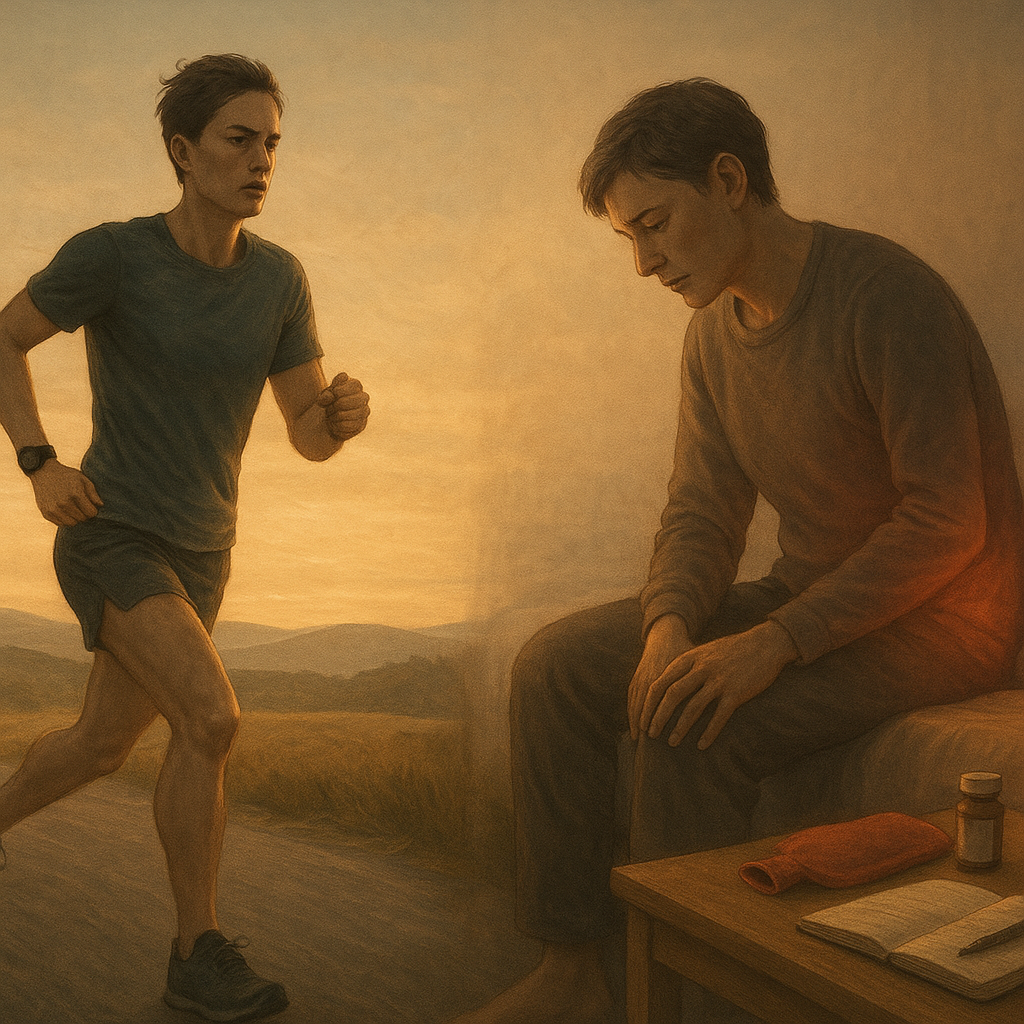
People often ask me why I do ultras - very long distance runs or triathlons.
Specifically, they ask why someone with Ankylosing Spondylitis—a disease prone to fusing the spine and causing immense mechanical pain—would voluntarily sign up for Double, Triple, and Quintuple Ironmans or 100 mile races. Why would I subject a body that has already known so much trauma to 160-kilometer runs and days of nonstop physical exertion?
The answer usually surprises them. I didn’t start doing ultra-endurance events to punish myself. I started doing them because I realized I had been training for them (mentally) during my entire autoimmune ordeal, without knowing it.
In 2018, before I found my path to remission through plant-based nutrition and lifestyle changes, my “sport” wasn’t swimming, biking, or running. My sport was getting out of bed. My marathon was navigating a workday while my sacroiliac joints felt like they were on fire. My sprint finish was trying to cross a street before the light turned red, hoping I could make it.
When I eventually toes the line at an ultra-race, looked around at the other athletes, and saw the anxiety in their eyes about the upcoming “suffering,” I realized something profound. I didn’t learn how to endure pain on the racecourse. I brought that skill with me from the patient experience.
And if you are reading this while navigating an autoimmune condition, I want you to know something important: You are already an ultra-athlete. You just haven’t been given your medal yet.
The relentless nature of the “Invisible Ultra”
In the world of extreme sports, we talk a lot about “The Pain Cave.” It’s that dark mental place you go to 15 hours into a race when your glycogen is depleted, your muscles are screaming, and your brain is begging you to stop. Ultra-athletes are celebrated for their ability to sit in that cave and keep moving forward.
But for those of us with chronic autoimmune conditions, the Pain Cave isn’t a place we visit on weekends for a shiny belt buckle. For a long time, it was our bedroom. It was our living room. It was where we lived and worked.
Patients with chronic illness endure a level of physical and mental load that would break the average healthy person and. a lot of endurance athletes. We manage energy levels with the precision of a Tour de France cyclist. We navigate pain thresholds that would send most people to the emergency room. We do this without aid stations, without cheering crowds, and often without a finish line in sight.
That is the definition of grit.
Shifting the Narrative: Victim vs. Athlete
There is a heavy psychological burden that comes with a diagnosis. We are often framed as “sufferers” or “victims” of our disease. The medical language is passive: we are treated, we are managed, we are observed.
But I want to propose a radical shift in mindset. I want you to stop seeing yourself as a victim of bad genetics or misfortune, and start seeing yourself as an elite endurance athlete in the middle of the hardest event of your life.
When you shift your identity from “patient” to “athlete,” everything changes.
1. Athletes Fuel, They Don’t Just Eat A victim eats, sleeps for comfort or restriction. An athlete for performance. When you view your body as a high-performance machine that is currently fighting a massive internal unexpected load (inflammation), you stop looking at a automimmune protocol as an elimination diet, as a “restriction.” It becomes your race fuel. You aren’t skipping the processed sugar because you “can’t have it.” You are skipping it because it compromises your performance and recovery.
2. Athletes Respect Recovery In the ultra world, if you don’t sleep, you don’t recover. Rest is an active part of the sport. As chronic pain warriors, we often feel guilty for resting. We feel lazy when flare-ups demand we stay in bed. But if you view this through the lens of an athlete, that rest is structural. It is necessary physiological repair. You are not “doing nothing”; you remain in active recovery mode so you can fight another round tomorrow.
3. Athletes Dissociate and Persevere Ultra-runners use a technique called dissociation to separate their minds from the screaming in their legs. Chronic pain patients are masters of this. We have learned to hold a conversation, smile at a dinner party, or finish a report while our bodies are shouting at us in volume ten. That is a mental callous that takes years to develop. It is a superpower.
The Grit of the Long Haul
The hardest part of an ultra-race isn’t the steep hill; it’s the distance. It’s the knowledge that after running for 20 hours, you still have 10 more to go.
Autoimmune disease is exactly this. It is the grit of the long haul.
It requires a specific type of mental fortitude to wake up in pain and decide to move anyway. To stretch anyway. To prepare a green smoothie anyway. To meditate even when your mind is racing.
This is why I say this topic is sensitive, but also vital. I do not want to romanticize pain. Pain is awful. It steals joy, it steals time, and it steals energy. But since the pain is there, we have a choice in how we frame our relationship to it.
If we view it as a senseless tragedy, we remain victims. But if we view our endurance of it as a testament to our strength, we reclaim our power.
You Are Stronger Than You Think
When I am at kilometer 80 of a run, and my body wants to quit, I think back to the days before my remission. I remember the nights I lay awake sweating, unable to turn over. I remember the fear. And I realize that running a race is honestly easier than active disease. In a race, I chose the suffering, and I know it will end at the finish line.
You, dealing with the unpredictability of a flare-up, are doing something much harder. You are navigating the unknown.
So, give yourself some credit. Stop comparing yourself to the “healthy” version of you or to the people around you who seem to have endless energy. They are running a 5K on a flat road. You are running 100 miles through the mountains with a weighted backpack.
If you are just surviving right now, that is okay. Survival in an ultra is a victory. If you are crawling, that is okay. Forward progress is forward progress.
But never let anyone—including yourself—tell you that you are weak. The fact that you are here, reading this, looking for answers, and trying to improve your health proves that you have the spirit of an ultra-endurance legend.
You have the grit. You have the endurance. You have the strength. Now, let’s treat your body with the respect that an athlete deserves and get you to your own personal finish line.
Be always kind to yourselves and keep moving forward.